
Loans can be a good option if you need to extend your financial resources. They can even help you start a new chapter in your life — for instance, by purchasing a home. However, some loans can have predatory terms, including payday loans. The Consumer Financial Protection Bureau and certain state governments have issued rules concerning payday loans.
Understanding the key differences between installment loans and payday loans should help you make an informed decision. When comparing these loan types, consider the total cost of the loan and how it impacts your finances long term.
Installment Loans vs. Payday Loans Breakdown
The main differences between payday and installment loans include:
| Installment Loans | Payday Loans | |
|---|---|---|
| Interest Rates and Fees | Significantly lower rates and manageable fees | Exorbitant and predatory rates or fees |
| Repayment Terms | Longer repayment terms that can last for several months or years | Short-term loans that last a few weeks or until the next payday |
| Credit Score Impact | Can positively or negatively impact credit scores depending on payment timeliness | Can negatively impact credit scores if the lender turns over the loan to a collection agency |
| Eligibility Considerations | Creditworthiness, income, and repayment capability | Age and income |
| Main Benefit | Flexible loan amounts with reasonable rates | Easy application |
| Main Drawback | More considerations for loan approval | Limited loan amounts with extremely high fees |
| Best Use Case | Can be ideal for personal use, such as purchasing a home or for emergencies | Should only be considered if legal and during emergencies if no other option is available |
What Is an Installment Loan?
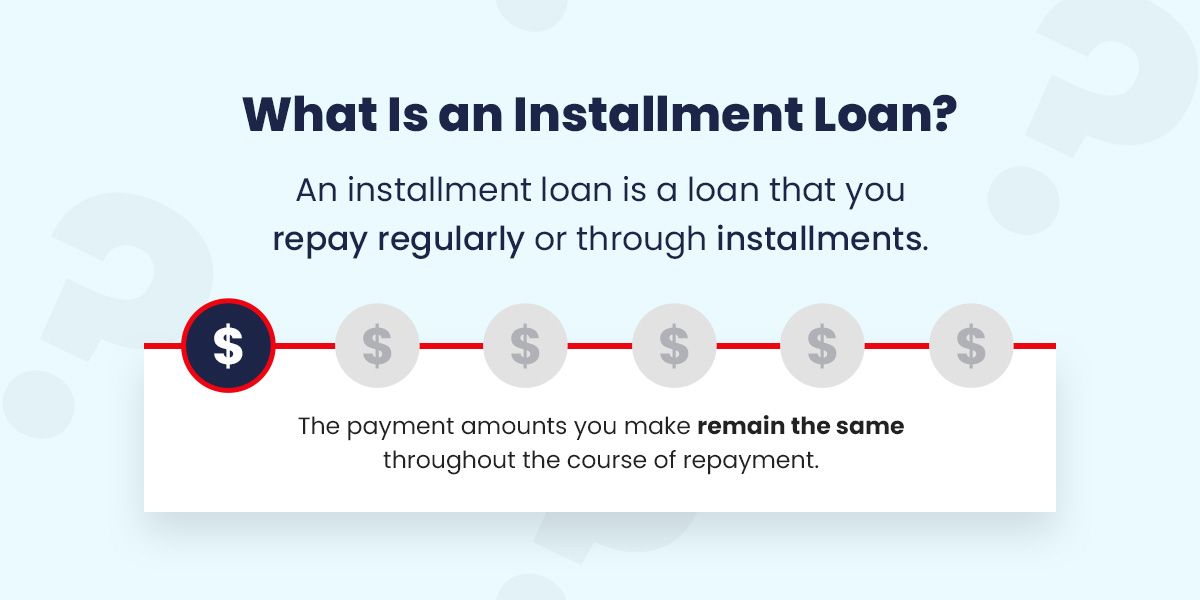
An installment loan is a loan that you repay regularly or through installments. These loans are often fixed-payment loans, meaning the payment amounts you make remain the same throughout the course of repayment. These loans can be personal or commercial. Examples include mortgage loans, auto loans, and student loans.
Installment loans can also be secured or unsecured. Secured loans require collateral, which is an asset you pledge to offer as security to the lender. For instance, mortgage loans often require the house you purchase as collateral. Unsecured loans don't require collateral.
Installment loans are widely available from banks, credit unions, and online lenders.
Loan Amounts, Interest Rates, and Fee Structures
You can borrow any amount, provided it's within the lender's specified range. The loan comes with an annual percentage rate (APR), which comprises the interest rate and other lender fees. Other fees can include origination fees, which are processing fees for your application. The Truth in Lending Act (TILA) requires lenders to disclose the APR before you sign an agreement.
Extra charges, such as late fees, aren't part of the APR. Learning about the potential fees should help you determine if the loan is worth taking. Compared to payday loans, installment loans offer lower rates. The cost ultimately depends on the risks associated with lending.
Lenders consider these factors:
- Creditworthiness: Lenders review your credit reports and credit scores to determine eligibility. Higher credit scores can result in lower rates. However, some lenders, like Atlas Credit, still offer installment loans to those with low credit.
- Collateral: Collateral reduces lender risk. Hence, secured installment loans can offer lower rates.
- Income: Lenders review your income and employment history to understand your financial stability. For instance, they may favor you if you have a high income or if you've been in the same job for multiple years.
- Debt-to-income (DTI) ratio: DTI shows your ability to take on a new loan. The more loans you have, the less your financial capacity for repayment. This lack of capacity poses risks for lenders.
- Requested loan terms: Long installment loan terms can lead to higher APRs. Shorter terms lead to faster repayments and therefore are less risky.
Loan Repayment Structure
Each payment comprises a portion of your total loan amount and interest. If you have a fixed-rate installment loan, you'll be making similar, predictable payments. Payments are often due monthly or on a similar regular schedule. Some lenders charge penalties for advanced payments.
If you want to be able to pay ahead of time, carefully review your loan terms. You can also ask your lender if you have this option. If you're a military member, you're protected by the Military Lending Act (MLA). The MLA is a federal law that prohibits a lender from charging penalties to active-duty servicemembers or covered dependents for paying off a loan early.
Application Process
Once you find a lender, you'll fill out an application in person or online. You typically need to specify the loan purpose, such as if you need the loan to purchase a car. Your lender may then discuss:
- Down payment: Higher down payments can lead to lower interest rates.
- Loan term: Longer terms can get you a lower monthly payment.
- Payment schedule: You may need to repay the loan weekly, biweekly, monthly, quarterly, or on another schedule.
In reviewing your application, the lender considers the amount and terms they can actually offer. Despite the typical eligibility criteria, you can still get approved if you have low credit. However, you may have better chances with a secured loan due to the collateral.
Pros and Cons of Installment Loans
When considering an installment loan, consider the benefits and drawbacks.
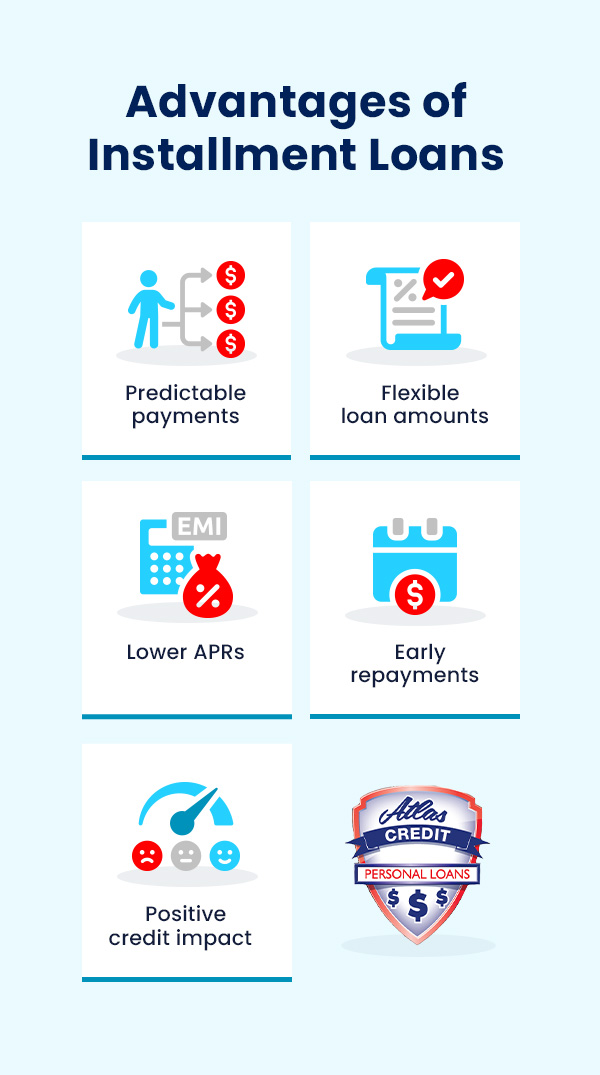
Some advantages of installment loans include:
- Predictable payments: Particularly with fixed-rate loans, installment loans can be easy to budget for due to the established repayment terms.
- Flexible loan amounts: You can apply for a loan amount based on your needs. Taking out a smaller loan can save you on interest and fees. If you qualify, you could consider a larger loan to cover more expenses.
- Lower APRs: You can get a substantially lower APR from installment loans. This lower rate can protect you from falling into a debt trap, where charges compound when you fail to make payments.
- Early repayments: Some lenders let you pay off your loan early, which can help you get out of debt faster.
- Positive credit impact: Timely loan repayments build your credit score and reflect well on your credit history.
While these benefits are great, installment loans also come with drawbacks:
- Miscellaneous fees: Installment loans come with different fees, such as origination fees and late payment fees. Review the terms carefully to understand the total cost of the loan.
- Tempting loan amounts: It can be tempting to take out a loan larger than you actually need. The unnecessary amount adds to your interest payments and can negatively impact your budget.
- Long-term commitment: Long repayment schedules require commitment. You must be able to stick to your budget and stay on top of the loan.
- Potential loss of collateral: Failing to pay secured loans can result in the loss of collateral. For instance, if you default on your auto loan, the bank can take away your car.
- Negative credit impact: Payment failures can affect your credit score by appearing on your credit history.
What Is a Payday Loan?
There's no set definition of a payday loan. These loans are generally considered short-term loans with extremely high interest rates. You usually have to repay them immediately, typically with your next paycheck. Missed payments can quickly lead to ballooning debt and fees.
These high-interest loans have different names across the U.S.:
- Cash advance loans
- Post-dated check loans
- Deferred deposit loans
- Check advance loans
Only 37 states allow payday loans, since these loans are considered predatory. State regulations on payday lending vary, but 11 jurisdictions don't have specific provisions. Opting for installment loans can be the safer option.
Loan Amounts, Interest Rates, and Fee Structures
Payday loan amounts are typically limited to up to $500. Your eligibility depends on your income, not your financial capacity to pay. Payday loans are often unsecured loans. You may receive the money in cash, check, prepaid card, or electronic deposit.
Some states limit maximum fees on payday loans. These fees range from $10-$30 for every $100 loan. Payday lenders often show charges as a fixed fee per $100 instead of an interest rate. For instance, if you opt for a two-week loan of $100, the lender may charge a $15 fee, which is equivalent to an APR of 390%. In comparison, a four-year auto loan averaged to a 7.53% APR in November 2025.
Military members can take advantage of the MLA's protection from predatory interest rates. The Act limits payday and consumer loan interest rates to 36%, known as the Military Annual Percentage Rate.
Loan Repayment Structure
Unlike installment loans, payday loans are often single-payment loans. You typically need to pay back the loan after two to four weeks, which is often your next payday or when you receive payment from another income source. For instance, you may pay the loan through your pension or Social Security. Some lenders may allow you to repay the loan in installments.
Lenders may require a post-dated check or bank account access to withdraw funds for repayment. Some states allow rolling over the loan into a new loan if borrowers can't repay the debt. However, this rollover costs more fees and can set up a debt trap. Review your loan terms carefully, as the TILA requires payday lenders to disclose their fees.
Unlike installment loan lenders, payday lenders typically don't report payments to the credit bureaus. Your credit score can't improve with timely payments. If you fail to repay the loan, the lender may turn the loan over to a collection agency. If this happens, the loan can show up on your credit reports and negatively impact your credit score. Lenders may hire collection agencies after failed attempts to collect repayment.
Application Process
Payday loans are designed for quick applications. Online or storefront payday lenders can approve your application within minutes. To qualify, you generally must:
- Be at least 18 years old.
- Have a government ID.
- Present a proof of income.
- Provide a bank account access or a post-dated check.
Payday lenders often don't run a credit check. Because loans are unsecured, you won't need to pledge collateral.
Pros and Cons of Payday Loans
To make a payday loan comparison against installment loans, consider the payday loan's benefits and drawbacks.
The benefits include:
- Accessibility: Payday loans are accessible, provided they're legal in your state. Lenders don't review your credit score in your application.
- Easy approval: Because lenders approve applications within minutes, you can access the money you need immediately.
Despite the benefits, these major drawbacks can impact your long-term financial situation:
- Bank fees: Lenders that have access to your bank account can attempt to withdraw funds multiple times. If you don't have sufficient funds for repayment, this can lead to multiple overdraft fees from your bank. TLenders are legally allowed to make two withdrawal attempts.
- Rollover risks: Rolling over the loan into a new loan leads to more fees. These fees add up, which can even amount to your original loan amount. The loan may not be worth taking, considering the exorbitant fees.
- Debt trap: Since the lender doesn't consider your financial capacity to pay, it's easier to fall further into debt if you have other loans to repay. Installment loans can serve as a good alternative, considering you don't need a lump sum for repayment.
Which Is the Better Option?
Installment loans can be a significantly better financing option, given the risks and high fees associated with payday loans. Longer terms also make repayment manageable and budget-friendly. If you're struggling with low credit, lenders like Atlas Credit can provide loan options while offering the chance to rebuild your credit score. The many types of installment loans also make them ideal for your personal goals.
Frequently Asked Questions
Apart from learning the key differences between installment loans and payday loans, consider these answers to common questions to help you choose the better loan type:
How Are Payday Loans Different From Other Loans?
Payday loans come with extremely high fees and are considered predatory loans. Many states prohibit these loans, while others have lending restrictions. Repayments are often due in a lump sum, typically on your next payday. Installment loans can offer a safer, more manageable repayment schedule.
Is It Easier to Get a Payday Loan or an Installment Loan?
It can be easier to get a payday loan because there are fewer requirements and eligibility criteria. However, you can't get these loans in states that prohibit them. Installment loans can also be easy to apply for, provided you meet the lender's requirements. You can apply online or in person.
What Is Better Than a Payday Loan?
Installment loans from trusted lenders are often better than payday loans. Check whether the lender has good customer feedback, as a loan requires you to commit to working with them. Also, carefully review the loan terms. Take note of all potential fees before you decide which loan is worth taking.
Why Trust Atlas Credit
Atlas Credit has been working with consumers since 1968, offering loans with a wide range of terms. We provide top-of-the-line customer service, whether we're servicing clients in person or online. You'll find our brick-and-mortar locations across different states, but you can also easily apply online. We don't let low credit scores impact applications.
Get a Loan From a Trusted Lender
The key differences between installment loans and payday loans are stark, revolving around fees, safety, and flexibility. As a consumer loan company, Atlas Credit can help you choose the best personal loan. We have terms ranging from $100 to $1,800. We'll walk you through every loan detail, including monthly payment requirements, due dates, and the total cost of the loan.
Submit an application online today or visit one of our physical locations near you. You'll find our branches in Missouri, Oklahoma, and Texas.